
The IAF has planned several activities at the air base to commemorate the 20 years of the war and the symbolic recreation of the Tiger Hill attack was one of them.

'The US and India continue to use their deepening relationship to build new partnerships within and beyond the Indo-Pacific.'

The Chinese have just one commander for all the forces confronting India. Commanders of all these forces answer to one man, and one headquarter. India, on the other hand, offers a diversity of options that is a military embarrassment in the 21st century. In Arunachal and Sikkim-Bhutan, the Eastern Army Commander is in charge. In the Uttarakhand (central) sector, it will be the Central Army Commander. The Himachal-Tibet border is the domain of the Western Army Commander. And all of Kashmir and Ladakh further on, the Northern Army's. Effectively, an array of at least eight 'three-star' commanders will be arrayed against one Chinese, says Shekhar Gupta.
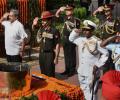
Defence Minister Manohar Parrikar on Wednesday indicated that the post of Chief of Defence Staff could be a reality soon, a day after Prime Minister Narendra Modi marked defence reforms as a priority and stressed that "jointness at the top" was a need long overdue.

India's doctrinal policy shift in combating terror by carrying out the Balakot air strikes inside Pakistan, appointment of a Chief of Defence Staff and hastening work on military modernisation marked a new beginning in 2019 in dealing with complex security challenges.

In an address to the air warriors on the occasion of the 89th Air Force Day, the Chief of Air Staff also said that the IAF must demonstrate to the nation that external forces will not be allowed to violate its territory.
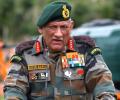
Gen Rawat is due for retirement on December 31 and top government sources said, if everything goes according to plan, then the government would name him as the country's first CDS before he hangs up his boots.

Unless each attack drone can be neutralised, India will be literally deploying elephants to stamp out ants -- and the ants may still survive! points out N Sathiya Moorthy.

The Indian Navy has deployed a range of its frontline warships and submarines in the Indian Ocean region to send a clear message to China following the escalation of the border dispute in eastern Ladakh.

Colombo seems to be veering to the middle path between China and the US on global matters, but in regional matters of strategic security, it is increasingly identifying with India, points out N Sathiya Moorthy.

Access to Sabang Port will allow the Indian Navy to dominate Malacca Strait more effectively, reports Ajai Shukla.
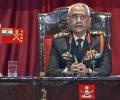
Army chief General M M Naravane on Tuesday hoped for an amicable resolution of the military standoff with China in Ladakh through talks based on 'mutual and equal security' even as he said India will have to be prepared to deal with a 'two-front' threat scenario due to the potent and collusive threat from China and Pakistan.

After a 7-year hiatus, Pakistan Monday showcased its growing military might, including tactical nuclear missiles and fighter jets, at a joint tri-service parade to celebrate the National Day in a symbolic show of strength in the war against the Taliban.

5 planes and 13 ships are out trying to track the aircraft, which was carrying 29 people on board.
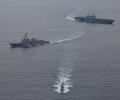
At any time, there is a need to operationally deploy two aircraft carriers in the vast Indian Ocean, asserts Vice Admiral Premvir Das (retd).
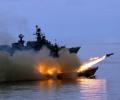
An impressive array of warships, including nuclear capable submarines, and about 8000 men and officers of Indian Navy presented an exquisite display of operational capabilities in an exercise reviewed by Prime Minister Narendra Modi off the Kochi coast in Kerala on Tuesday.

Swaraj expressed satisfaction over the agenda of the inaugural dialogue while giving the details of the deliberations.

'In the Balakot operation, we had technology on our side, and we could launch precision stand of weapons with great accuracy.'
As India's international role expands, so must our capabilities, says Brigadier Gurmeet Kanwal (retd).
'For Pakistan, the comfortable old calculations and certainties are no longer valid.' 'Strikes on Indian targets now carry a high risk of retaliation and escalation,' notes Ajai Shukla.

Navy chief Adm. Sunil Lanba said that by 2050, India will have 200 ships, 500 aircraft.

'The military aim in a future conflict, if it can't be avoided, should be to cause maximum damage to the adversary's war waging capability and capture limited amount of territory as a bargaining counter,' says Brigadier Gurmeet Kanwal (retd).

The navy finds itself fighting for relevance, with navy planners lamenting that its share of the budget has dropped dramatically.

'This is a historic juncture when the US is in great need of an alliance with India to strengthen its hands in the fierce struggle with China in the Asian theatre,' points out Ambassador M K Bhadrakumar.

'In the present era of strategic uncertainty and rapidly changing threats, no military professional now disputes the unavoidable necessity of a joint planning staff for the planning and conduct of joint operations so that integrated operations can be planned 'top down',' says Brigadier Gurmeet Kanwal (retd).

Prime Minister Modi felt there were too many silos with no arrangement to take a comprehensive view on national security. The PM has entrusted NSA Ajit Doval to evolve a comprehensive roadmap and get it implemented, reveals Nitin Gokhale, Editor-in-Chief, Strategic News International.
The new minister must commit himself to supporting long-term defence plans or else defence modernisation will continue to lag and the growing military capabilities gap with China will assume ominous proportions, warns Brigadier Gurmeet Kanwal (retd).

'India appears to have stood its ground on strategic autonomy by resisting US pressure on Russia, China and Iran, but succumbed to the temptation to walk into a tighter embrace in defence cooperation, a high priority of the Trump administration,' notes Ambassador T P Sreenivasan.
Amongst those who heard the message of the Bihar results would be Defence Minister Manohar Parrikar, whose realm is simultaneously the country's most complex and -- when something goes wrong -- the most emotive, says Ajai Shukla.
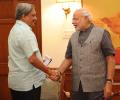
The National Democratic Alliance government has adopted half measures instead of moving decisively on defence.

Excerpts from Prime Minister Narendra Modi's speech at the Combined Commanders Conference on board the INS Vikramaditya at sea, off the coast of Kochi.

'It is the government's most important duty to ensure that when war breaks out, the armed forces are absolutely ready to face the adversary -- well equipped, well trained and in high spirits,' says Brigadier Gurmeet Kanwal (retd).
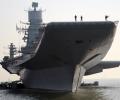
The navy wants to spend Rs 40,000 crore on INS Vishal, a choice the army and air force oppose. This is as much about turf as about funding. explains Ajai Shukla.
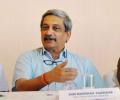
Instead of ramming through change, Mr Parrikar has tied his own hands by placing reform at the mercy of numerous committees, says Ajai Shukla.

The defence minister has 20 months to learn the military's ethos, culture and to publicly bat for an organisation that feels increasingly marginalised and underappreciated.

The Modi government has not lived up to the muscularity the prime minister promised while campaigning, says Ajai Shukla

Why does the army remain embroiled in counter-insurgency, denying itself a peace dividend even after expending blood and treasure in imposing calm?
 © 2026 Rediff.com - Advertise with us - Disclaimer - Privacy Policy - Sitemap - Feedback - About us - Terms of use - Grievances